
- Harendra Kumar
- July 6, 2026
- Clinical Trials
- 0 Comments
Everyone Is Talking About Real-Time Clinical Trials.
Few Are Talking About What It Will Take to Deliver Them.
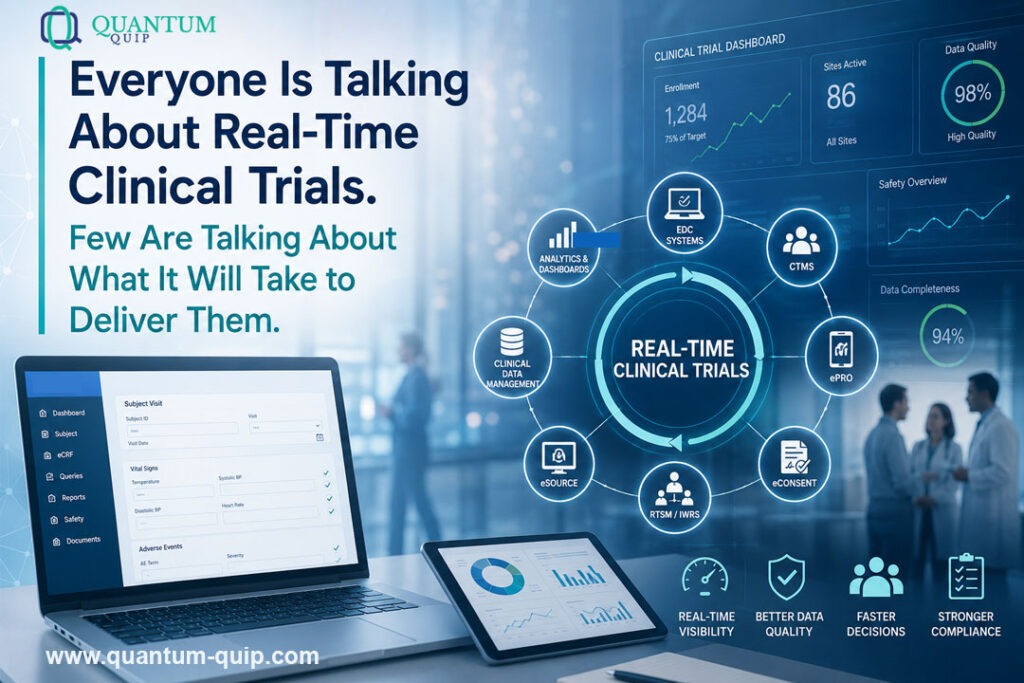
The FDA’s recent comments around Real-Time Clinical Trials (RTCTs) have sparked a lot of discussion in clinical research. Most of it has focused on what this could mean from a regulatory standpoint—and that makes sense.
But honestly, that’s only part of the story.
The bigger question is whether the industry is actually ready to operate in a truly real-time clinical trial software ecosystem powered by modern EDC systems, and integrated clinical data management platforms.
For years, clinical trials have run on reporting cycles. Data is collected through Electronic Data Capture (EDC software), stored in clinical trial databases, cleaned, reconciled, reviewed, and then shared at specific intervals.
RTCTs, at least in concept, challenge that entire rhythm.
From Reporting to Real Visibility
Traditionally, clinical trials have been built around structured reporting using systems like EDC platforms, clinical trial management platforms (CTMS), and clinical trial data capture systems.
Teams look at data periodically. Safety boards review trends in scheduled meetings. Sponsors compile updates. Regulators review processed datasets after reconciliation in clinical data management software.
That system works—but it’s slow. And more importantly, it creates a gap between data capture in electronic case report forms (eCRF) and actual decision-making.
Real-time trials shift the focus from reporting to visibility.
Instead of asking, “When will we get this data?” the question becomes, “Can we trust what we are seeing in our clinical trial database software right now?”
That might sound like a small change, but it really isn’t. It changes how decisions are made across the entire trial.
Technology Isn’t the Problem Anymore
Most organizations don’t have a technology problem.
They have a workflow problem.
Today’s clinical trials already use sophisticated technology.
EDC.
ePRO.
eConsent.
eSource.
RTSM.
CTMS.
Analytics platforms.
On paper, the ecosystem looks complete.
Yet during implementations, study teams are manually moving data between systems, reconciling information from multiple sources, and waiting for updates before they can make decisions.
The challenge isn’t that the tools don’t exist.
It’s that they often don’t work together the way clinical teams expect them to.
There are examples of studies where data is captured in one system but isn’t visible where it needs to be for hours—or even days.
Many discrepancies remain unnoticed simply because different teams were looking at different versions of the same data.
There are experienced professionals spending valuable time copying information between systems instead of reviewing the data itself.
That’s why the next phase of innovation isn’t about adding another application to the technology stack.
It’s about making the existing ecosystem behave like one connected platform.
Because once data starts moving seamlessly, the conversations change.
Clinicians are no longer asking:
“Has the data arrived?”
They’’re asking:
“Can we act on it?”
And that’s a much more valuable question.
There have been many implementations where the sponsor had invested in almost every major eClinical system—EDC, ePRO, CTMS, RTSM, safety, analytics. It looked like a best-in-class technology stack. But the study team was still maintaining Excel trackers because the systems weren’t talking to each other in a way that supported their day-to-day workflow. That experience changed how I think about innovation. More software isn’t always the answer. Better integration usually is.
Data Readiness Is Becoming the Real Advantage
In the past, companies stood out based on things like enrollment speed, site relationships, therapeutic expertise, or global reach.
Those still matter—but something new is starting to show up.
That’s data readiness.
The ability to get high-quality data from source to decision quickly and confidently is becoming a real differentiator in clinical trial software ecosystems.
Some organizations are already quite far along here. Others still rely heavily on manual steps, disconnected systems, and delayed reviews. And that gap is going to matter more as expectations evolve.
The Real Questions to Ask
Even if RTCTs aren’t part of your current trials, the direction of travel is pretty clear.
So the more useful questions might be:
- How quickly can we actually spot issues when they show up?
- Can we see study performance clearly without waiting for a full data cycle?
- How hard is it to get a complete, reliable picture of what’s happening right now?
- Do we really trust our data at any given moment inside our clinical trial data management systems?
These aren’t future problems—they’re already here in different forms.
Where This Is Really Going
Real-time clinical trials probably aren’t the end goal.
They’re more like a step toward something bigger: a clinical research ecosystem that’s more connected, more transparent, and faster to learn from.
In that kind of environment, everyone—sponsors, sites, CROs, regulators, and even patients—benefits from better and faster insights powered by clinical trial software platforms, EDC systems, and integrated clinical data management tools.
But getting there isn’t just about technology or data speed.
It’s about whether organizations can actually make information flow cleanly, reduce friction in operations, and build trust in the data they use every day.
The FDA’s RTCT direction is just a signal of where things are heading.
The real question now is simpler:
Are we actually ready for it?
Because whether we are or not, the shift is already starting.