
- Harendra Kumar
- July 19, 2026
- Clinical Trials, EDC
- 0 Comments
How AI-Powered Electronic Data Capture Software Is Transforming Clinical Trials in 2026
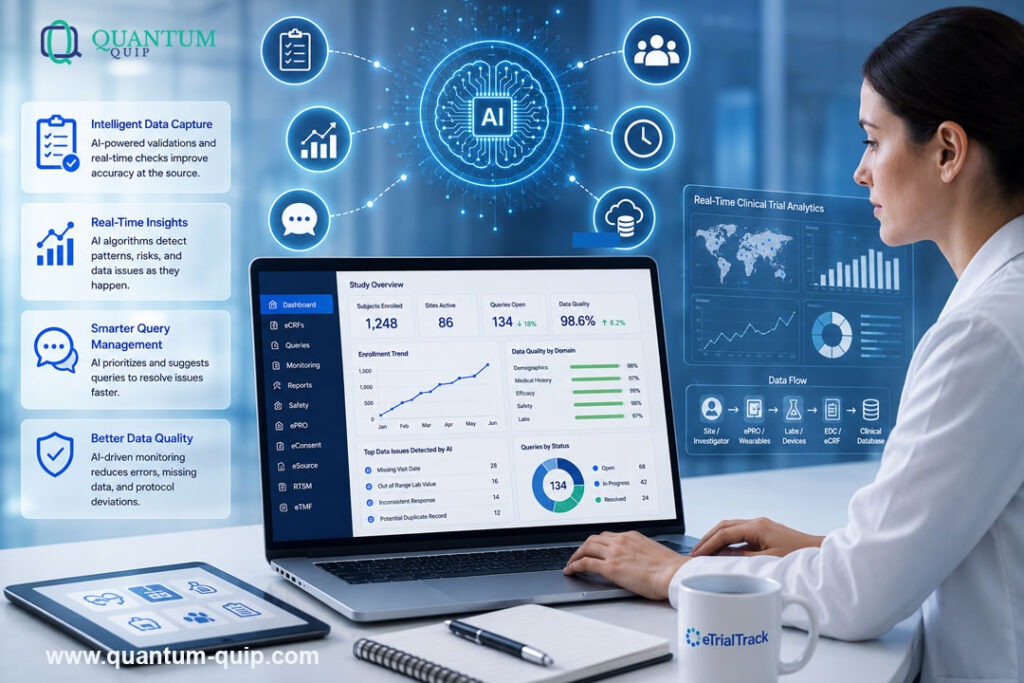
If you’ve worked on a clinical trial, you know that collecting data is only half the job. The harder part is making sure every piece of information is accurate, complete, and ready when someone needs it.
A missed patient visit, an incorrectly coded adverse event, or a delayed lab result may not seem like a major issue on its own. But when a study spans dozens of sites and hundreds of participants, small gaps like these can quickly snowball into hundreds of data queries, additional monitoring visits, and delayed database lock.
This isn’t a new challenge. Clinical research teams have dealt with it for years.
What’s changed is the scale of today’s studies.
Clinical trials are now more connected than ever. Investigators work across countries, patients complete questionnaires from home, wearable devices continuously generate health data, and sponsors expect real-time visibility instead of waiting for weekly status reports. The amount of information flowing into a study has increased dramatically, and managing that information has become just as important as collecting it.
That’s one of the biggest reasons Electronic Data Capture (EDC) Software has become a standard part of modern clinical research.
Early EDC systems solved an important problem by replacing paper Case Report Forms with digital records. Today’s platforms go much further. A modern Clinical Data Management Software solution supports the entire journey of study data—from designing Electronic Case Report Forms (eCRFs) and validating entries to resolving queries, tracking protocol deviations, generating reports, and maintaining a complete audit trail.
At Quantum Quip, we’ve watched expectations around clinical technology change considerably over the last few years. Research teams no longer ask for software that simply stores data. They want a platform that fits naturally into the way they work, reduces manual effort, and gives every stakeholder—from investigators and monitors to sponsors and data managers—a clear view of what’s happening across the study.
That’s the thinking behind eTrialTrack, our integrated clinical research platform.
Rather than treating Electronic Data Capture, ePRO, eConsent, eSource, RTSM, Medical Coding, and eTMF as separate tools, eTrialTrack brings them together in one connected environment. The goal is straightforward: reduce unnecessary complexity so research teams can focus on running studies, not managing multiple systems.
Artificial Intelligence is adding another layer to that evolution.
Despite all the headlines, AI isn’t replacing clinical researchers, data managers, or medical reviewers. Clinical research depends on human expertise, scientific judgement, and regulatory oversight—things no algorithm can replicate.
Where AI is proving useful is in the routine work that takes up so much of a team’s day.
Instead of manually reviewing thousands of records, AI can draw attention to unusual patterns that deserve a closer look. It can highlight missing values before they become outstanding queries, identify sites with increasing data discrepancies, support medical coding, and help study teams prioritise tasks based on risk rather than volume.
These improvements may sound incremental, but that’s often how meaningful progress happens in clinical operations. Saving a few minutes on every patient record, resolving queries earlier, or identifying potential issues before a monitoring visit can make a noticeable difference over the course of a large study.
For sponsors and CROs, those gains translate into cleaner data, smoother study execution, and better visibility throughout the trial. For investigators and site teams, they mean less administrative work and more time focused on patient care.
Technology alone doesn’t make a clinical trial successful.
People do.
The best technology simply removes the obstacles that prevent those people from doing their best work. That’s where AI-powered Electronic Data Capture Software is beginning to make a real difference—not by changing the science behind clinical research, but by making the everyday work of running a study more efficient, more connected, and ultimately more reliable.